

Asset Pipeline
Generation
Section titled “Generation”Procedural generators in Blender produce every mesh, LOD chain and texture set in the mod.
- Source: the generator is the asset. A change is a rebuild, never a hand edit of an exported file.
Budgets
Section titled “Budgets”Triangle and texture budgets per asset class, taken from comparable vanilla assets of the same footprint and role, then set by judgment.
- Caps: a cap is a ceiling. Detail beyond it goes into the texture.
- Textures: 512² minimum per map, any kind.
| Class | LOD0 cap | LOD1 | LOD2 |
|---|---|---|---|
| A-Frame Day Lodge | 16,000 | ≤ 0.5 × LOD0 | ≤ 500 |
| Mountain Hut | 6,000 | ≤ 0.5 × LOD0 | ≤ 500 |
| Chalet Lodge | 12,000 | ≤ 0.5 × LOD0 | ≤ 500 |
| Swanky Summit Lodge | 18,000 | ≤ 0.5 × LOD0 | ≤ 500 |
| Swanky Grand Lodge | 33,500 | ≤ 0.5 × LOD0 | ≤ 500 |
| Ski School | 7,000 | ≤ 0.5 × LOD0 | ≤ 500 |
| Patrol Hut / Patrol HQ | 2,000 / 2,500 | ≤ 0.5 × LOD0 | ≤ 500 |
| Ski Bus Depot | 2,500 | ≤ 0.5 × LOD0 | ≤ 500 |
| Chairlift and gondola towers | 3,800 to 5,000 (fixed-grip breakover twins 5,400) | ≤ 0.5 × LOD0 | per asset |
| Lattice towers | 6,100 | ≤ 0.5 × LOD0 | per asset |
| Tram towers | 5,800 to 8,000 | ≤ 0.5 × LOD0 | per asset |
| Lift stations | 3,600 to 13,000 | ≤ 0.5 × LOD0 | per asset |
| Chair or cabin with its grip | 642 to 2,724 (tram 8,256) | ≤ 0.5 × LOD0 | per asset |
| Sheave wheel | 120 | 28 | none |
Texturing
Section titled “Texturing”Repeating swatches up close, small per-asset maps at distance.
- Tile sheet: one shared 4096² sheet of material swatches per building family at LOD0. Faces are cut to swatch size so repeats come from reuse, as in vanilla.
- Far maps: each asset carries its own maps for LOD1 and LOD2.
- Own atlas: the Ski Bus Depot bakes one 2048² atlas from scans tinted to its palette, at about 100 px/m, below the wall band.
- Texel density: held in a band per surface class. Target for building walls: the vanilla band of 340 to 520 px/m. Large station surfaces: 120 to 200 px/m. Roof-edge trim: strip-mapped along its length at 400 px/m across, at no triangle cost.
- Material split: the vanilla set. Base color, normal, mask, control mask (recolor channels), emissive.
- Fine detail: features under 5 cm live in the normal map and span at least 3 texels. Weathering is low frequency and opaque.
Detail Allocation
Section titled “Detail Allocation”Triangles go where a player reads them at play distance. Texture and normal map carry the rest.
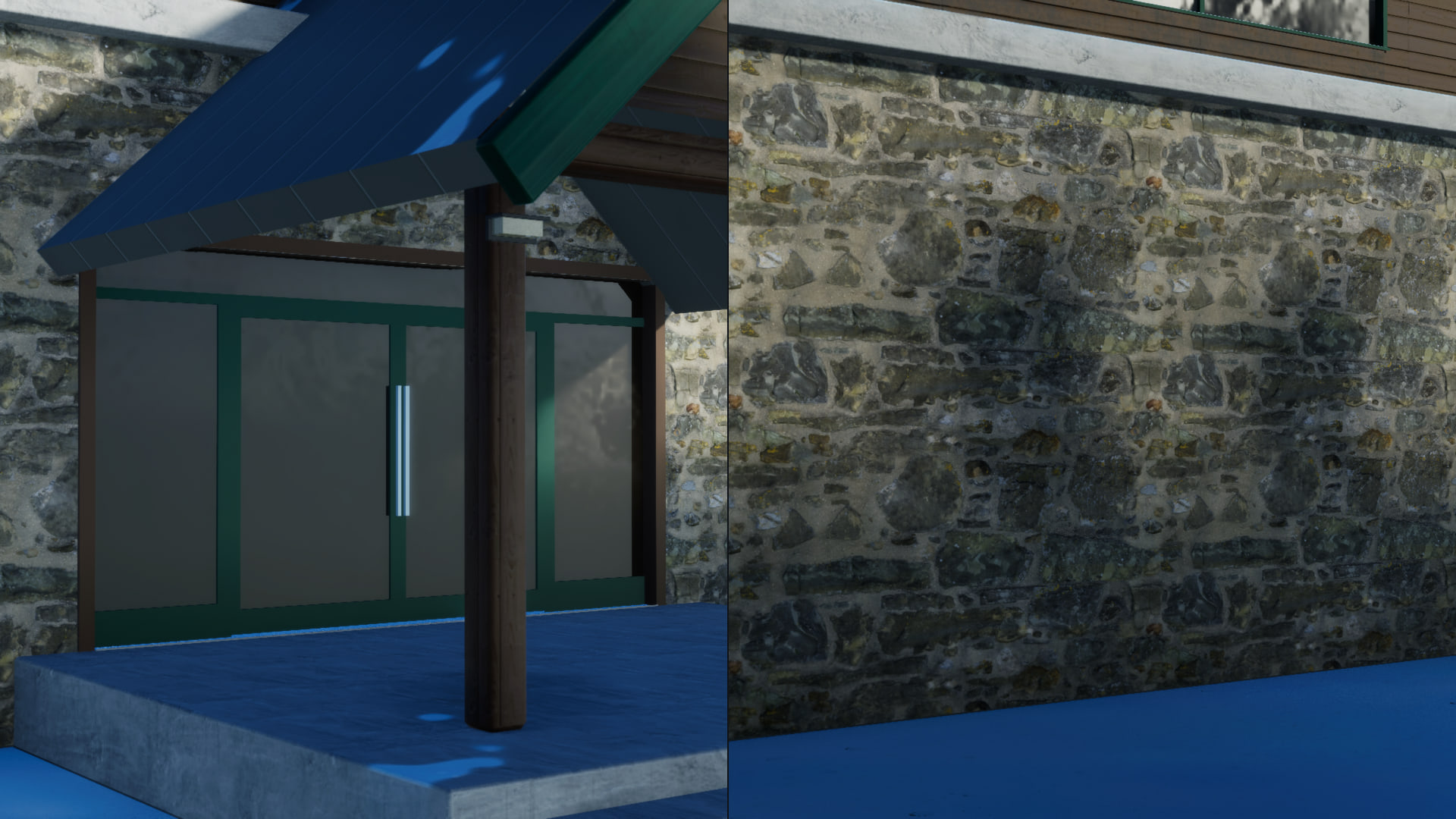
- Spent on: entrances (recessed doors with casing, threshold and hardware on every leaf), glazing (glass set back in a real opening with casings and sills), roof edges, chimneys and flues, lift machinery (sheave trains and wheels).
- Held back on: large plain walls (few quads on a swatch), undersides, small relief (seams, bolts and grain in the normal map), hidden faces, far LODs.
- Structure: every fitting touches its support within 5 mm. Nothing crosses glass.
Vanilla First
Section titled “Vanilla First”Where the game has a prop, fixture or detail, the asset uses it.
- Method: the game’s own sub-objects, referenced by GUID: rooftop units, vents, wall lights and lanterns, benches, bins, racks, fences, poles and trees.
- Benefit: vanilla detail, consistent with the rest of the city, at 0 triangles against the asset’s cap.
- Modeled in-house: only what the game lacks, such as chimney crowns, string lights, patrol beacons and lift machinery.
- Ski Bus Depot: the shelter, sign tower and corten planter are modeled. The bench, bin, lamp, trees and rocks are vanilla.
- Ski bus coach: the game’s own bus meshes, with 0 new triangles. The SKI BUS livery is a decal on the sides and roof, so it reads as paint.
Recolor Channels
Section titled “Recolor Channels”Three recolor channels per building, through the game’s color picker.
- Channels: red, green and blue of the control mask = slots 1, 2 and 3.
- Palette: one palette per building. Every part takes its color from the building’s own set.
Review Loop
Section titled “Review Loop”Every asset passes the same gates from preview to play.
- Preview: rendered previews, including LOD and recolor views, reviewed before export. No export without approval.
- Import: through the game’s Editor, one action per texture-sharing group.
- Prefab wiring: the gameplay prefab is pointed at the new mesh and given its color, LOD and emissive properties.
- Automated checks: triangle and LOD budgets, LOD ratios, texel density, texture names and sizes, prefab validity, vanilla references.
- Field test: the asset placed and played in a city, day and night, before it ships.